
In this article
Who resolves compatibility problems after a game is generated? Jiemian’s reporting on Xingxia offers a concrete example: creator Li Xinlei and product staff maintaining a shared Git repository. That detail moves the platform question beyond generation to whether an author can keep the published work running.
What the reporting establishes
Jiemian reporter Li Shuyao describes NetEase’s Xingxia as a platform in testing at the time of reporting. Creator Li Xinlei’s game encountered compatibility problems, and product staff worked with her on a shared Git repository. The report also describes an invitation highlighting platform save functionality. These are reported experiences and platform statements, not features independently tested by GameScope.
What is visible now
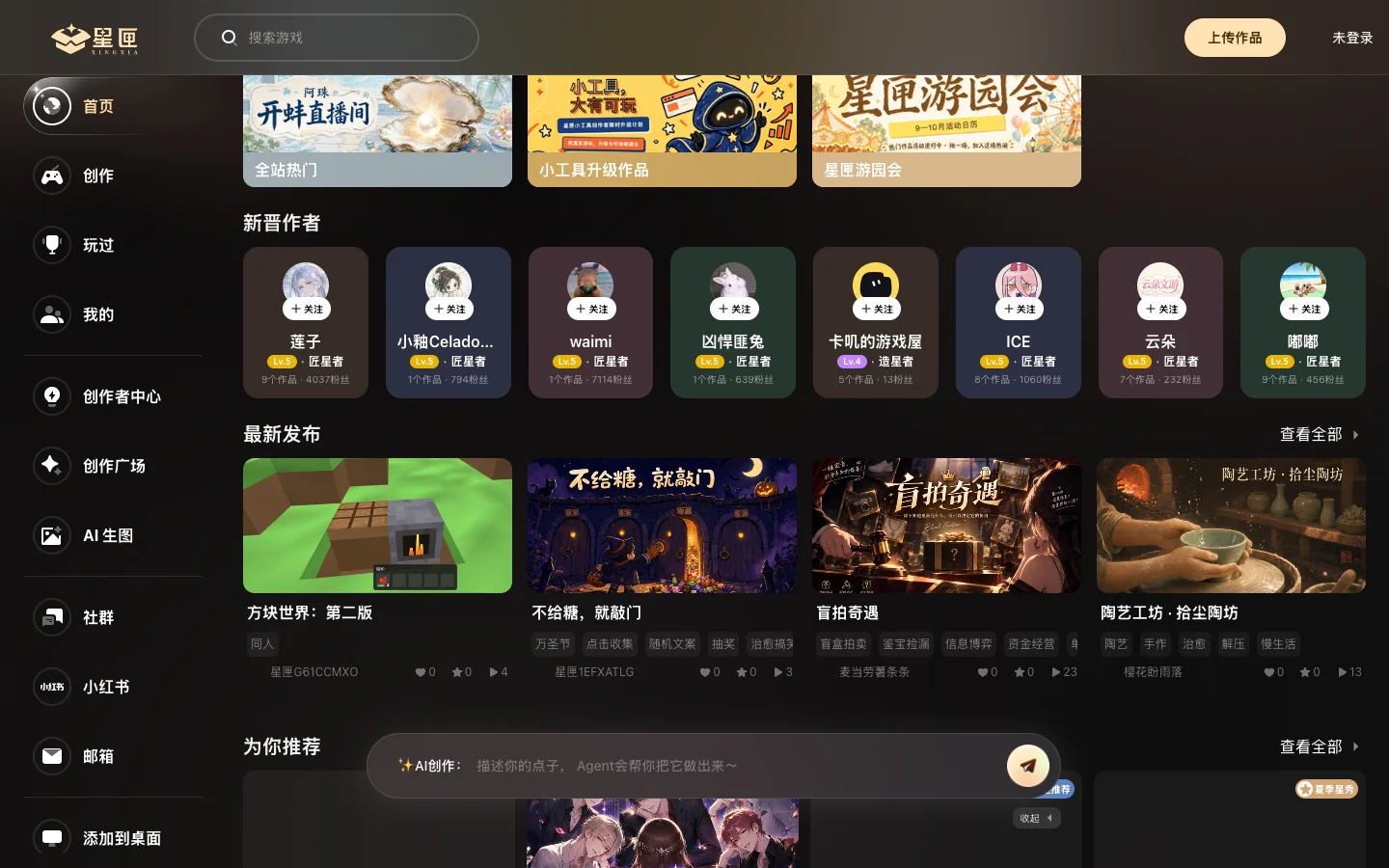
On October 12, we checked the public homepage. It presents community projects and separate creation, creator-center and AI-image entries. Clicking creation while signed out led to a login page. We did not generate a project or play the listed games.
That distinction matters when reading the screenshot: it documents a discovery surface, not the quality of the editor. A large library cannot establish how many revisions an individual game required, whether it exports successfully, or how reliably it preserves player progress.
Adaptation is a development task
Our interpretation is that creator support can become a meaningful platform advantage when it helps a project survive deployment. A game that runs in its author’s browser can still fail when embedded elsewhere: its canvas may size incorrectly, asset paths may change, or input focus may be lost. Fixing those problems requires a reproducible project and a clear division of responsibility.
A shared repository is useful only when the creator understands what changed. Before adopting platform-specific code, keep a working baseline and identify which services it calls. This gives the creator a way to compare behavior and estimate the work required to publish elsewhere.
Progress is part of the player experience
For a short puzzle, a reset may be acceptable. For a collecting or management game, losing progress can undo the reason to return. Any save system needs assessment beyond the existence of a save button: account association, behavior after updates, and recovery when a request fails all affect the player.
These questions are especially important when a game moves between hosts. A creator should establish whether existing progress can move too, whether a new login is required, and who handles support when a player cannot recover a save. We have not verified those conditions for Xingxia.
What to examine before joining
| Decision | Evidence to request |
|---|---|
| Bring an existing game | Supported build format and an adaptation example |
| Depend on player saves | A returning-player check across sessions and updates |
| Seek an audience | How a new release enters recommendations and how results are measured |
| Preserve future options | Downloadable project contents and dependencies on platform services |
Xingxia is worth following as a combined creation and discovery platform. Its current public page and the reported creator relationship answer different questions; together they justify further investigation, without establishing export quality or typical creator outcomes. The tool profile records our access checks separately from this analysis.